
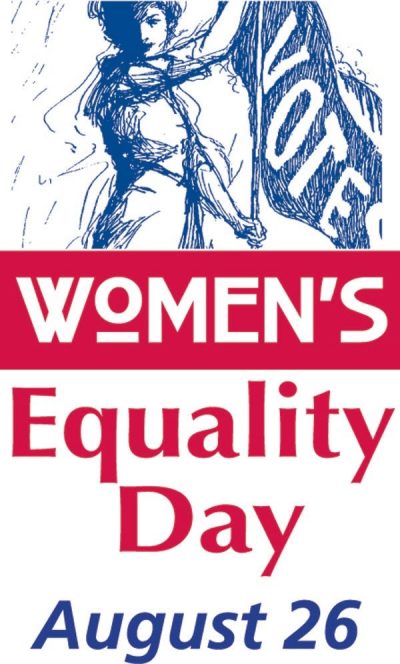
August 26, the anniversary of the ratification of the 19th Amendment in 1920, is also celebrated in the United States as Women’s Equality Day. It was first officially designated as such in 1973 by President Richard M. Nixon. Women’s Equality Day also honors the progress in women’s rights made over the course of American history.
As we remember this victory we want to pause for a moment and reflect on just how tremendous this achievement was, considering from where our foremothers began. Their initial struggle in the 1820s and 1830s was against slavery and on behalf of education reform. But when the women delegates from the US were not seated at the Anti-Slavery conference in London in 1840, key leaders such as Elizabeth Cady Stanton and Lucretia Mott decided to hold their own conference, which took place in Seneca Falls, NY in 1848, and thus, the modern American women’s movement was officially born.
Yet, before the movement fought for suffrage, their focus had been on ending the restrictions of the so-called “coverture” system. Coverture laws had their roots in British common law and had been continued in the US since 1776. Coverture meant that married women’s legal, economic and political identity and their physical body were fully controlled (“covered”) by their husbands. Thus, a married woman could not control her own property or money, regardless of whether it was inherited or earned through wages. She owned no personal property, not even the clothes she wore, nor the jewels her husband gave her. She could not bring a lawsuit for injury to her person, nor was her testimony in court sufficient to convict; and she could not serve on a jury. She could not make a will. Her husband could physically punish and restrain her. She had no control over her children’s upbringing, or even their company, as her husband could transfer guardianship to a third person by deed or will. No woman could vote or hold office once universal male suffrage had become the law in the 1820s and 1830s.
The significance of the 19th amendment must therefore be seen within the context of the multiple challenges women had to overcome, before suffrage was even feasible to be contemplated as the next goal. At the time of the amendment’s ratification in 1920, women had not only gained the right to vote but had also made great inroads in earning full legal and economic, as well as political and personal freedoms. The 19th amendment gave women full citizenship status by enabling them to vote, run for office, serve on juries (albeit not on Federal juries until 1968), and to testify in court, sign contracts and own a business outright. These hard-won rights and privileges, while supported by the Constitution would continue to be infringed upon or denied to many Black women in the deep South, Asian American women, especially in California and elsewhere, until President Johnson signed the Civil Rights Act 1964 and the Voting Rights Act 1965 into law. They were also only applicable to Native American women after 1924, when Native Americans were finally recognized as American citizens.
Even after 1920, some aspects of coverture remained in place, far into the late 20th century, such as mortgage companies would not consider the wife’s income for a first mortgage as it was presumed she would stop working once she had a child (1960s); or that wives would need the permission of their husband before opening a separate checking account (1970s), and the fact that domestic violence and marital rape were not considered prosecutable crimes until the 1990s. To this day, we can still see traces of coverture when married women are referred to by their husband’s first and last name, rather than their own first name and his last name.
As we celebrate the success and significance of the 19th amendment’s passage on National Women’s Equality Day, we want to also remember that we still have mountains to climb until all women and girls in America are safe and free to enjoy their unalienable right to life, liberty and the pursuit of happiness.
Submitted July 31, 2026
Christiane Warren, Ph.D.
The Dover Century Club Historian
GFWC Delaware Historian
References
- https://www.archives.gov/founding-docs/declaration-transcript
- https://www.gilderlehrman.org/history-resources/essays/seneca-falls-convention-setting-national-stage-womens-suffrage
- https://www.lbjlibrary.org/life-and-legacy/civil-rights
- Maynard, Douglas H. “The World’s Anti-Slavery Convention of 1840.” The Mississippi Valley Historical Review 47, no. 3 (1960): 452–71. https://doi.org/10.2307/1888877.
- “Women’s Equality Day.” National Women’s History Alliance, nationalwomenshistoryalliance.org/resources/commemorations/womens-equality-day
- Stretton, Tim, and Krista J. Kesselring, eds. Married Women and the Law: Coverture in England and the Common Law World. McGill-Queen’s University Press, 2013. http://www.jstor.org/stable/j.ctt32b7jq.
- https://medium.com/walawlibrary/excluded-from-the-jury-box-women-and-jury-service-8e9e1ea153d7
- https://femmefrugality.com/myth-busting-womens-banking/
- https://engagedscholarship.csuohio.edu/cgi/viewcontent.cgi?article=1610&context=clevstlrev